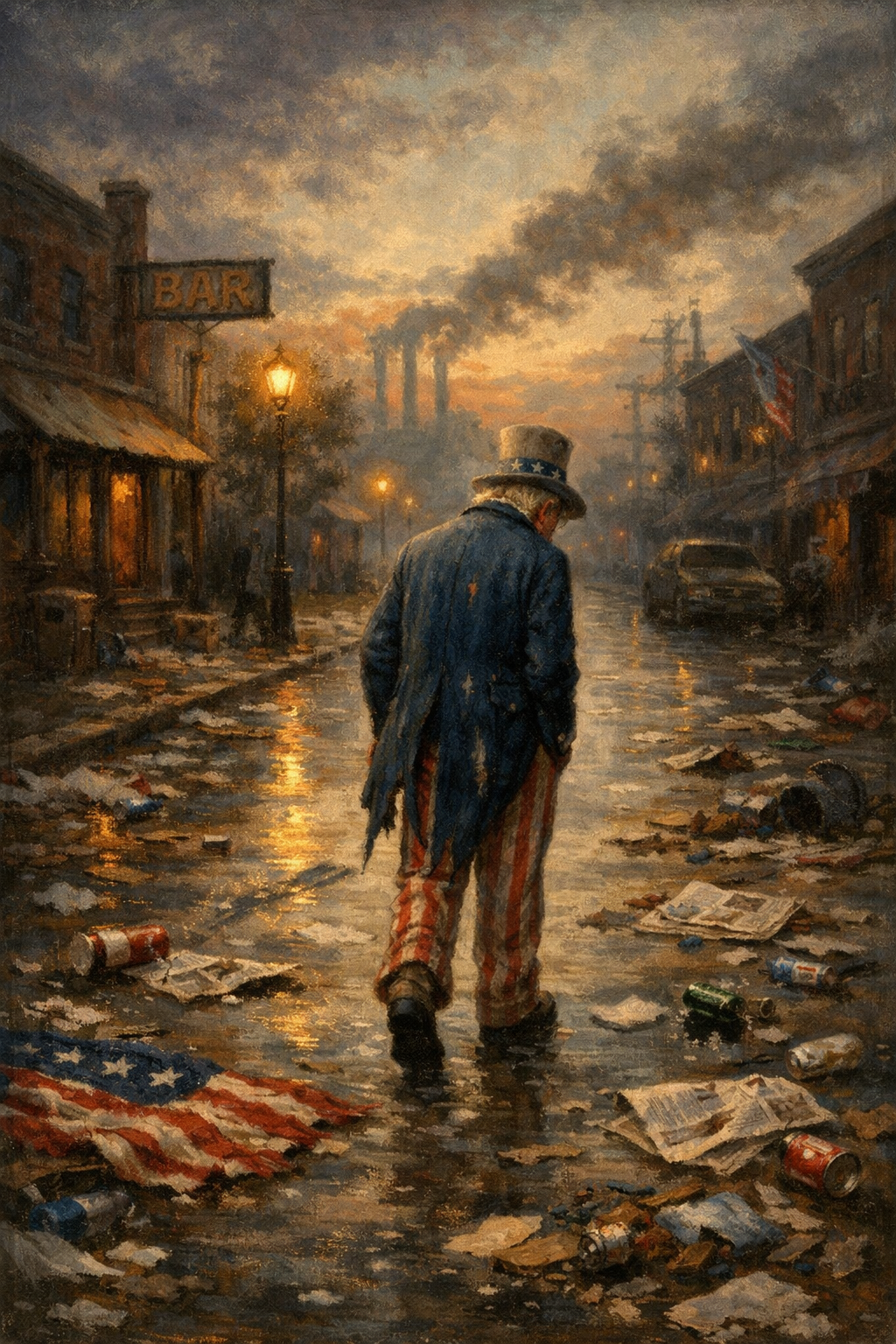

My family has lived in what is now the United States since before it was the United States. Before flags and anthems, before constitutions and slogans, before we even knew what “America” was supposed to mean. We were here under colonial rule, here through revolution, expansion, civil war, and reinvention after reinvention. We were pioneers, then farmers, and finally businessmen. America is part of my DNA in a way that’s hard to explain without sounding dramatic—but it’s true.
That’s why it feels strange, and a little disloyal even admitting it, that I think about leaving.
I love this country. I love its landscapes, its contradictions, its stubborn creativity. I love the way people here still believe—sometimes foolishly, sometimes beautifully—that things can be better. I love the music, the writing, the open road, the sense that reinvention is not just possible but expected. America taught me to question authority, to value independence, to speak my mind. Those aren’t small gifts.
But loving something doesn’t mean ignoring what it’s become.
Our politics feel less like civic disagreement and more like permanent psychological warfare. Nuance is punished. Curiosity is suspect. If you don’t fully submit to one side’s narrative, you’re treated as an enemy or a fool. The noise is constant, exhausting, and deliberately polarizing. It’s hard to feel grounded when every issue is framed as an existential threat and every election as the last one that will ever matter.
What troubles me even more is how casually we treat the rest of the world.
America still talks about itself as a moral leader, but too often our actions don’t match the story we tell. We intervene, destabilize, sanction, and surveil—then act shocked when resentment follows. We export culture, capital, and conflict with equal confidence. We talk about freedom while cozying up to authoritarian regimes when it’s convenient. We lecture other nations about democracy while struggling to maintain our own.
We’re loud about our values but inconsistent in living them. And when we’re confronted with the consequences of our global behavior, we double down or look away rather than listen.
I don’t want to leave because I hate America. I want to leave because I love it enough to be disappointed.
There’s a particular kind of grief that comes with watching something you care about drift further from its ideals. It’s the grief of unmet potential. Of knowing we could do better—be better—but choosing comfort, power, or tribal loyalty instead. That grief doesn’t cancel out pride or gratitude. It sits alongside them, heavy and unresolved.
Sometimes I imagine what it would feel like to live somewhere quieter politically, where civic life isn’t a constant emergency broadcast. Somewhere the national identity isn’t built on declaring superiority, but on maintaining balance. Somewhere patriotism doesn’t require blindness.
I don’t know if that place exists. Maybe every nation has its own version of this disillusionment, and I’m romanticizing distance the way people always do when they’re tired.
What I know is this: wanting to leave doesn’t erase my roots. It doesn’t negate my love for this country or my respect for the generations before me who endured far worse and kept going. It’s simply an honest reaction to the present moment—a moment where America feels less like a shared project and more like a perpetual argument with no off switch.
I’m sure I’ll never actually go. My children and grandchildren are here. But the fact that I think about it at all says something important. Not just about me, but about where we are.
And if America is truly as strong as it claims to be, it should be able to hear that without flinching.
Keep on rambling…
Leave a Reply